Best overall: every-other-week standard cleaning. Best for busy households: weekly standard cleaning. Best for built-up grime: a deep clean followed by recurring visits. This 2026 guide helps you choose a schedule for your Miami home office and decide what to confirm with Golden Sparkle Cleaning before booking.
- The best cleaning plan for remote workers starts with every-other-week standard cleaning when the home needs routine upkeep.
- Choose weekly standard cleaning when kitchen, bathroom and floor cleaning cannot wait between visits.
- Choose a deep clean before recurring visits when routine cleaning would leave existing buildup unresolved.
- Golden Sparkle Cleaning offers standard and deep house cleaning in Miami; confirm your home-office tasks before booking.
Why this matters
When you work from home, your workspace and living space share the same cleaning schedule. A clean desk does not solve a kitchen that needs attention. A full-house visit does not organize your paperwork.
Golden Sparkle Cleaning is a fit for Miami remote workers seeking residential cleaning rather than office management. The company provides standard and deep house cleaning. Choose the service around your home's condition, then discuss access to the room where you work.
The decision is not simply weekly versus every other week. You also need to separate routine upkeep, existing buildup and tasks you will keep handling yourself.
What makes the best cleaning plan for remote workers?
Use these five criteria for your 2026 cleaning schedule. Choose the plan that solves your actual cleaning problem, not the one with the longest checklist.
- Home condition: Routine upkeep and accumulated grime need different starting points. Identify the problem before choosing a frequency.
- Household workload: Include the kitchen, bathrooms and shared floors. Do not judge the whole home by how tidy the office looks.
- Workday disruption: Decide when a cleaner can enter your workspace and when noise would interrupt calls.
- Clear task boundaries: Separate accessible household surfaces from electronics, paperwork, cables and personal organization.
- A manageable gap: Choose a schedule you can maintain between visits without spending your weekend catching up.
Ask for the current scope and your quote before committing. Confirm whether the office is included, what needs clearing and how scheduling works. Do not assume that every task pictured in a general cleaning checklist belongs in your booking.
Cleaning plans at a glance
These are recommended service patterns, not named company packages. The comparison describes how to use residential cleaning, not a promise that every listed task is included.
| Plan | Best for | Standout feature | Key limitation |
|---|---|---|---|
| Every-other-week standard cleaning | Routine upkeep | Regular help while you handle small tasks between visits | The gap still requires household maintenance |
| Weekly standard cleaning | Busy households | A shorter gap between cleaning visits | More appointments to coordinate around work |
| Deep cleaning, then recurring standard cleaning | Built-up grime | Addresses the starting condition before maintenance | Does not replace choosing an ongoing schedule |
| Self-managed upkeep between professional visits | Hands-on upkeep | You control timing around calls and focused work | You remain responsible for completing the work |
Start with every-other-week cleaning unless your home's condition or household workload gives you a clear reason to choose something else. Being home all day does not, by itself, establish that you need weekly visits.
1. Every-other-week standard cleaning: best for routine upkeep
Every-other-week standard cleaning is the default recommendation for a remote worker whose home needs maintenance rather than a reset. Professional visits provide recurring help, while you handle dishes, spills, clutter and other everyday tasks between appointments.
This plan works when the home stays manageable between visits. If you repeatedly spend your free time catching up on bathrooms or floors, reassess the interval rather than adding more reminders to your calendar.
Every-other-week standard cleaning pros:
- Gives household cleaning a recurring place on your calendar.
- Leaves room to schedule appointments around work commitments.
- Separates professional cleaning from your daily tidying.
Every-other-week standard cleaning cons:
- Requires upkeep between visits.
- Does not address accumulated grime simply by becoming recurring.
- Still requires agreement about access to your workspace.
Best for: Remote workers who keep daily tasks under control but want regular help with residential cleaning.
Before booking, identify the rooms that need attention and explain whether your desk will be occupied. Ask Golden Sparkle Cleaning to confirm the standard-cleaning scope rather than assuming that computer equipment or desk organization is included.
Verdict: Buy every-other-week standard cleaning for routine upkeep; choose a different starting service if buildup is the main problem.
2. Weekly standard cleaning: best for busy households
Weekly standard cleaning suits a home where shared spaces need attention before an every-other-week appointment comes around. The reason to choose it is the household workload, not the presence of a laptop.
Consider this schedule when kitchen use, bathroom cleaning and floor maintenance keep overtaking the time you have available. Compare the whole home's needs with the work you are willing to do yourself.
Weekly standard cleaning pros:
- Shortens the gap between professional visits.
- Provides a regular place in the week for household cleaning.
- Supports a routine when several shared spaces need frequent attention.
Weekly standard cleaning cons:
- Requires more appointment coordination than every-other-week cleaning.
- Still leaves daily chores and personal organization with you.
- Does not automatically expand the scope of a standard visit.
Best for: Remote workers whose household cleaning needs consistently outgrow an every-other-week schedule.
Choose an office-access window before discussing appointment timing. If your calls move around, explain the constraint and ask what arrangements are possible. Do not assume a particular arrival time, room order or team assignment without confirmation.
Verdict: Buy weekly standard cleaning when the shorter interval solves a recurring household problem; skip it when routine upkeep already stays manageable.
3. Deep cleaning, then recurring visits: best for built-up grime
A deep clean followed by recurring standard cleaning separates two decisions: getting the home back to a maintainable condition and keeping it there. Choose this route when your concern is existing buildup rather than the time between appointments.
Describe the specific areas that concern you. Bathroom grout, cabinet fronts and neglected edges are useful topics to discuss, but the provider must confirm the actual scope. A service label is not a room-by-room agreement.
Deep cleaning followed by recurring visits pros:
- Addresses the home's starting condition before setting a maintenance routine.
- Makes it easier to distinguish reset work from ongoing upkeep.
- Gives you a clear point to reassess weekly versus every-other-week visits.
Deep cleaning followed by recurring visits cons:
- Requires agreement on both the initial service and the later schedule.
- Does not remove the need for daily household tasks.
- Does not make electronics, paperwork or specialist work part of the booking.
Best for: Remote workers whose homes need a reset before routine residential cleaning makes sense.
Golden Sparkle Cleaning offers deep cleaning and standard house cleaning in Miami. Ask which service fits your current condition and which tasks belong in each. If renovation dust is the issue, discuss post-construction cleaning instead of assuming a deep clean covers it.
Verdict: Buy the deep-cleaning reset when buildup is the obstacle, then choose recurring visits based on how the home holds up.
4. Self-managed upkeep: best for hands-on maintenance
Self-managed upkeep means you handle the everyday work between professional visits. It belongs in this comparison because even a recurring cleaning schedule leaves you responsible for immediate spills, dishes, personal items and workspace organization.
This is not another company service. It is the part of the plan you control, including when you stop working long enough to clear your desk.
Self-managed upkeep pros:
- Fits around calls without coordinating a separate appointment.
- Keeps sensitive documents and personal equipment under your control.
- Handles small tasks before they become a larger catch-up job.
Self-managed upkeep cons:
- Depends on you completing the tasks consistently.
- Competes with work and personal time.
- Does not replace professional cleaning you have decided you need.
Best for: Remote workers willing to maintain the space between scheduled residential cleanings.
As a suggested routine, set aside 5 minutes per workday for cups, rubbish and desk clutter. Add a 10-minute weekly review to identify household tasks that keep slipping. These are planning suggestions, not cleaning-time estimates or service promises.
If the same work keeps moving to next weekend, change the plan. A recurring task list is useful only when you have time to complete it.
Verdict: Hold self-managed upkeep as your between-visit routine; skip it as the sole solution when the work repeatedly goes unfinished.
Prepare your home office before a cleaning visit
A useful booking starts with clear instructions. You do not need to make the room spotless first, but you do need to distinguish cleanable surfaces from things that should remain untouched.
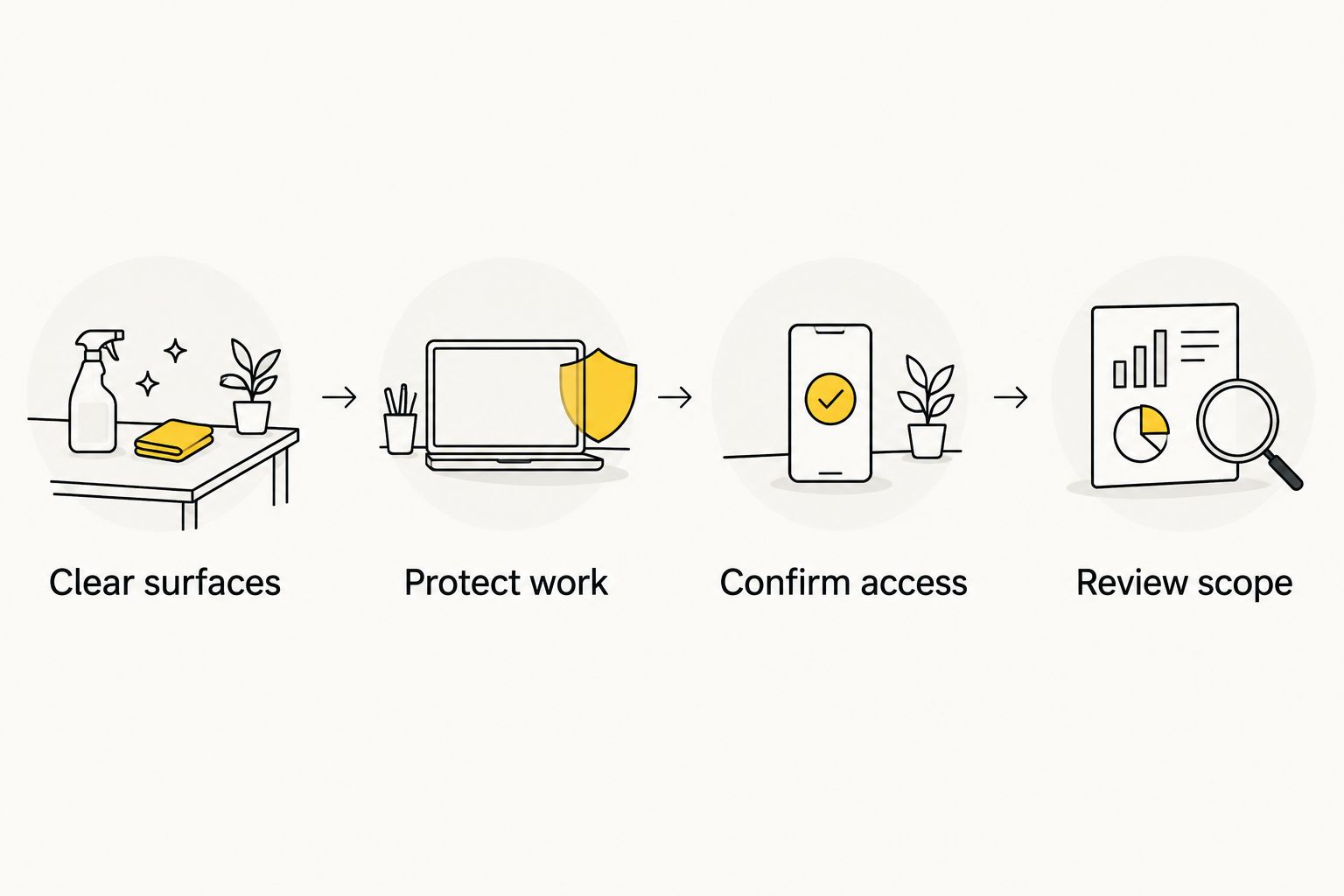
Use this preparation sequence:
- Clear surfaces: Put away loose paperwork, cups and personal items from areas you want cleaned.
- Protect work: Secure confidential documents and identify equipment or cables that should not be moved.
- Confirm access: Explain whether you will work in the room, step out or need it left alone during calls.
- Review scope: Confirm the agreed rooms, tasks and exclusions before the visit.
Ask how to communicate any change in room access. A meeting added to your calendar should not leave the cleaner guessing whether the office is available.
For a shared home office, agree with everyone using the room about what stays untouched. Keep that instruction simple and specific.
How these plans are ranked
The 2026 ranking prioritizes a manageable maintenance schedule, a match between service and home condition, clear task boundaries and workday access. It does not compare providers or claim tested cleaning results.
Every-other-week standard cleaning ranks first because it gives the undecided reader a practical starting point. Weekly cleaning takes the busy-household slot. Deep cleaning addresses buildup, while self-managed upkeep covers the work that remains between visits.
Which cleaning plan should you choose?
For 2026, choose every-other-week standard cleaning if your home needs routine upkeep and you can manage daily tasks between visits. Choose weekly cleaning when household cleaning repeatedly gets ahead of you. Start with a deep clean when the initial condition needs more attention.
Before booking Golden Sparkle Cleaning for recurring house cleaning, confirm:
- The service that matches your home's current condition.
- The rooms and tasks included in your quote.
- Whether and when the home office can be accessed.
- Current payment terms and scheduling arrangements.
- How to request a change if the interval is not working.
Choose your house cleaning service
Review your cleaning needs, then confirm the scope and schedule before booking.
FAQ
What's the best cleaning plan for remote workers in 2026?
Every-other-week standard cleaning is the recommended starting point when your home needs routine upkeep. Choose weekly visits for a heavier household workload or a deep clean first for existing buildup.
Should I book weekly cleaning if I work from home every day?
Book weekly cleaning when your household needs the shorter interval, not simply because you work from home. Consider the kitchen, bathrooms and floors alongside your office.
Do I need a deep clean before recurring cleaning?
Start with a deep clean when existing buildup needs attention beyond routine upkeep. Describe the home's condition and confirm the scope before choosing the initial service.
Will house cleaners clean my computer and keyboard?
Do not assume computer or keyboard cleaning is included in residential cleaning. Ask about equipment boundaries and identify anything that should remain untouched.
Can I stay home and work during the cleaning?
Confirm workday access arrangements with the provider before booking. Explain your calls, room restrictions and whether you can leave the office while it is cleaned.
What should I do between recurring cleaning visits?
Handle dishes, spills, rubbish, clutter and personal workspace organization between visits. If household cleaning repeatedly falls behind, reassess the service interval.
How do I compare quotes for home-office cleaning?
Compare quotes against the same rooms, tasks and frequency. Confirm whether the office is included, which tasks are excluded and what preparation is expected.
One last thing
Keep two lists: what needs cleaning and what needs putting away. A desk covered in documents needs a decision about those documents before its surface is accessible.
That distinction is the final check on your 2026 plan. Book residential cleaning for the agreed household tasks, protect your work materials and choose an interval you can maintain.